EP-160
-
Applying a hydroclimatological index to assess nitrate contamination in private drinking water wells across Iowa, USA from 1991-2011

P-010
-Normal variability
of biomarkerssexamined
in a “variability biobank”
E-Poster Details >Abstract
EP-160-
Applying a hydroclimatological index to assess nitrate contamination in private drinking water wells across Iowa, USA from 1991-2011
Presenting Author: Richard V Remigio
Authors: Richard V Remigio , Paula Masi Fleytas, Siddhi Munde, Maria Kamenetsky, Jesse E Bell, Mary H Ward, Laura Beane Freeman
Presenting Author: Richard V Remigio
Authors: Richard V Remigio , Paula Masi Fleytas, Siddhi Munde, Maria Kamenetsky, Jesse E Bell, Mary H Ward, Laura Beane Freeman
Topic:
Water Pollution
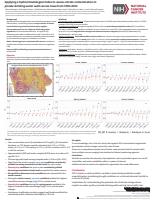
BACKGROUND AND AIM[|]Nitrogen fertilizer application and animal wastes are major sources of nitrate contamination in drinking water. Ingested nitrate can result in the formation of N-nitroso compounds –known potent carcinogens. Characterizing climate-driven influence on nitrate in private drinking water wells is scant. We evaluated the relationship between a probability-based precipitation index and measured nitrate concentrations from private domestic water wells (PDWs) within Iowa, USA, from 1991-2011.[¤]METHOD[|]We categorized standardized precipitation indices (SPI-1) representing precipitation conditions during the study period. Geocoded PDW measurements were linked to one-to-twelve-month precipitation totals for SPI-1 at sub-watershed levels. We calculated the cumulative lag effects of SPI-1 on nitrate in drinking water for up to twelve months using normal conditions as a referent group specific to year-round and calendar seasons. Generalized additive mixed models with random intercepts were used to estimate associations between SPI-1 and nitrate levels. Covariates included elevation, well depth, animal feeding operation facility distance, time, nearby hog facilities, and a bivariate spline representing PDW coordinates. Also, well locations were nested within subwatersheds to account for repeated measures.[¤]RESULTS[|]Among 23,378 PDWs, 2,850 samples (8.8%) exceeded the U.S. regulatory limit of 10 mg/L nitrate-nitrogen. We observed notable linear exposure responses for abnormal dry and wet for up to one-year (Lag 0-11) cumulative lagged SPI-1 during the year and all seasons except autumn. Severely dry (year-round: βLag0-11= -0.26, SE=0.06; growing-season: βLag0-11= -0.48, SE=0.18) and extreme wet (year-round: βLag0-11= 0.55, SE=0.08; growing-season: βLag0-11= 0.43, SE=0.12) conditions exhibited strong associations with nitrate levels. Significant cumulative effects were seen with very wet conditions between Lag 0-9 and Lag 0-11.[¤]CONCLUSIONS[|]SPI-1 is strongly associated with groundwater nitrate when considering short-term and long-term anomalous one-month precipitation totals. This work has implications for understanding the role of climate change-driven impacts on water quality in PDWs and long-term health risks.[¤]